
Ohm's Law Calculator
PrintOhm's Law Formula Reference Wheel
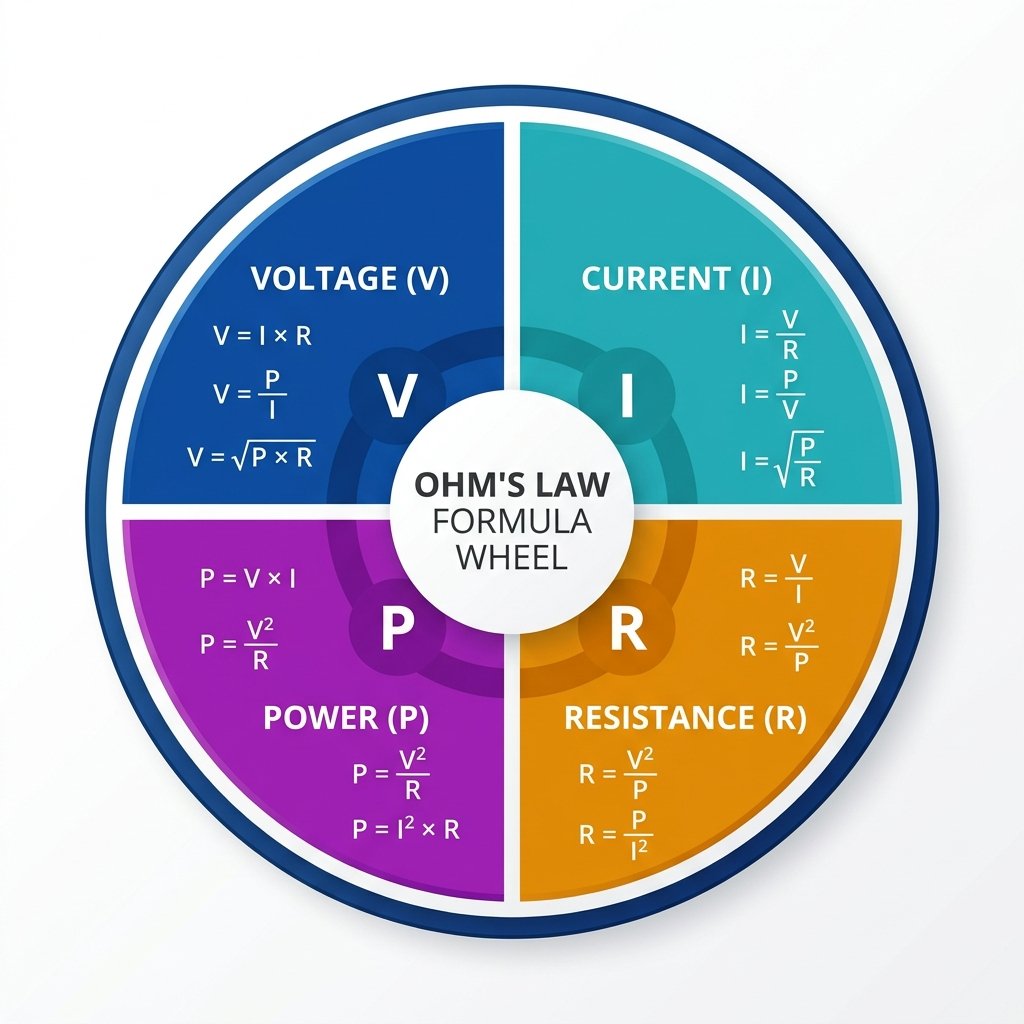
Analyzing simple circuits or troubleshooting electrical components requires understanding the mathematical relationships between voltage, current, resistance, and power. These fundamental properties dictate how electrical energy behaves in both domestic grids and complex microchips.
Our free online Ohm’s Law Calculator allows you to input any two known values to automatically determine the remaining two variables. It supports major metric prefixes:
- Voltage (V): Kilovolts (kV), Volts (V), Millivolts (mV).
- Current (I): Amperes (A), Milliamperes (mA).
- Resistance (R): Ohms (Ω), Kilohms (kΩ), Megohms (MΩ).
- Power (P): Watts (W), Kilowatts (kW), Megawatts (MW), Horsepower (hp), and BTU/h.
What is Ohm’s Law?
Ohm’s Law states that the electrical current flowing through a conductor between two points is directly proportional to the voltage across those two points. This relationship holds true for most conductive materials over a wide range of voltages and currents, meaning the resistance of the component remains constant.
Ohm’s Law applies to circuits consisting entirely of resistive elements (meaning no capacitors or inductors are present). It remains true regardless of whether the electrical source is Constant Direct Current (DC) or Time-Varying Alternating Current (AC).
The Core Equations
Ohm’s Law is defined by three interchangeable algebraic arrangements:
Voltage (V) = I × R(Volts)Current (I) = V ÷ R(Amps)Resistance (R) = V ÷ I(Ohms)
Where:
- Voltage (V): The electrical potential difference pushing the charges.
- Current (I): The rate of flow of electric charge (electrons per second).
- Resistance (R): The physical opposition the material presents to current flow.
Electrical Power and Joule’s Law
Electrical power is the rate at which electrical energy is transferred by a circuit per unit of time, traditionally measured in Watts (W). Power is supplied to appliances via electrical generators, grids, or batteries.
In purely resistive circuits, we can combine Joule’s Law with Ohm’s Law to calculate how much power is dissipated as heat:
P = V × I(Watts)P = V^2 ÷ R(Watts)P = I^2 × R(Watts)
These combinations let you calculate total power consumption even when you do not know the current or the voltage.
The Ohm’s Law Formula Wheel
The Ohm’s Law formula wheel is a circular matrix that summarizes the twelve algebraic relationships between Power (P), Current (I), Voltage (V), and Resistance (R). The table below outlines these relationships, showing how to solve for any variable in the center using your two known variables:
| Target Variable | Formula 1 (Knowns) | Formula 2 (Knowns) | Formula 3 (Knowns) |
|---|---|---|---|
| Voltage (V) | I × R (Current & Resistance) |
P ÷ I (Power & Current) |
√(P × R) (Power & Resistance) |
| Current (I) | V ÷ R (Voltage & Resistance) |
P ÷ V (Power & Voltage) |
√(P ÷ R) (Power & Resistance) |
| Resistance (R) | V ÷ I (Voltage & Current) |
V^2 ÷ P (Voltage & Power) |
P ÷ I^2 (Power & Current) |
| Power (P) | V × I (Voltage & Current) |
I^2 × R (Current & Resistance) |
V^2 ÷ R (Voltage & Resistance) |
To identify individual resistor band codes, check out our Resistor Calculator. To determine voltage loss in long wire runs, use the Voltage Drop Calculator.
Frequently Asked Questions (FAQ)
What is the difference between Ohm’s Law and Joule’s Law?
Ohm’s Law defines the relationship between voltage, current, and resistance (V = I × R). Joule’s Law defines the rate at which electrical energy is converted into heat (power dissipation, P = V × I). They are often combined in electrical engineering to solve for circuit values.
Can I use Ohm’s Law on AC circuits?
Yes, but with caveats. Ohm’s Law applies directly to AC circuits containing only resistive elements (like heating coils or incandescent bulbs). If the AC circuit contains reactive elements like capacitors or inductors, you must replace resistance with impedance (Z) to account for phase shifts.
What happens to current if resistance is doubled?
According to Ohm’s Law (I = V ÷ R), current is inversely proportional to resistance. If the voltage remains constant and you double the resistance, the electrical current flowing through the circuit will be cut in half.
Why do high-voltage power lines use small currents?
Power loss in a line is calculated using Joule’s Law (P = I^2 × R). Because power loss increases with the square of the current, electrical utility grids transmit power at very high voltages and low currents to minimize heat loss over long distances.